Identification Guide
Asagi Koi (浅黄)
The Asagi is one of the oldest and most historically significant varieties of Nishikigoi (ornamental koi), serving as the foundation from which many modern koi varieties have been developed. Originating in Japan during the early 1800s, Asagi are admired for their elegant simplicity, refined color balance, and graceful appearance rather than bold, dramatic patterns.
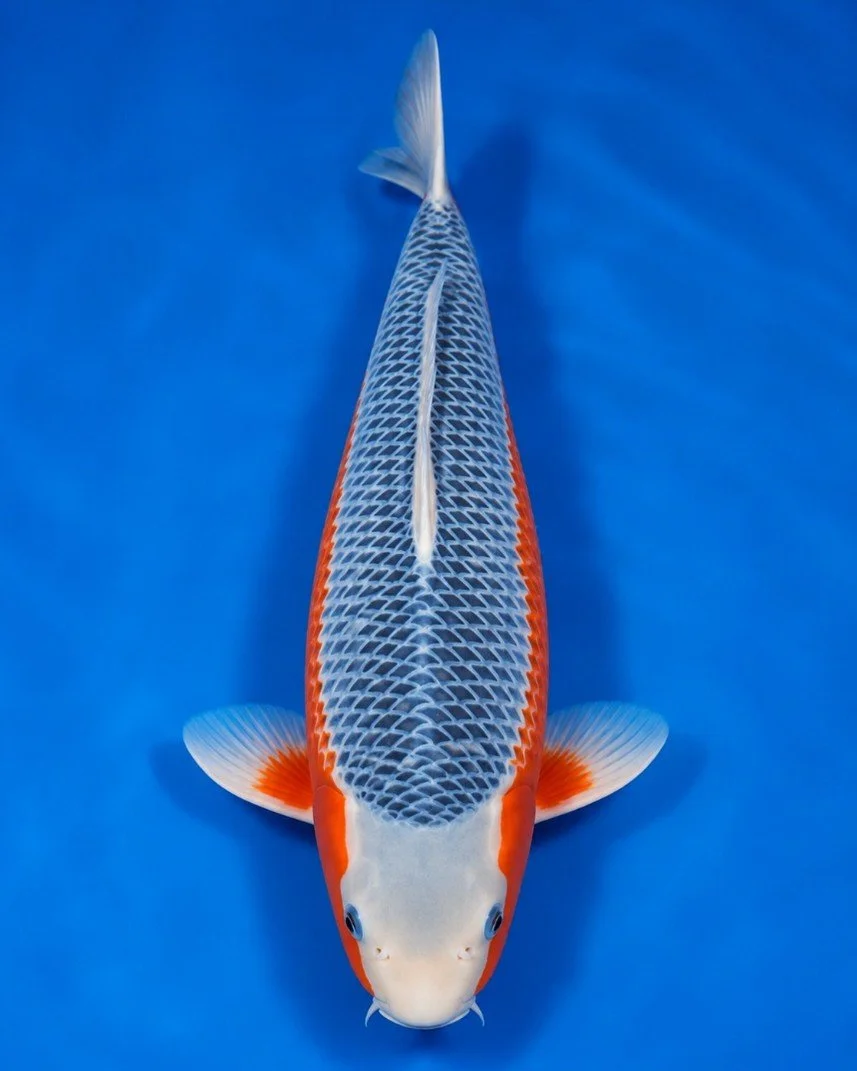
An ideal Asagi displays a beautifully symmetrical blue to gray-blue reticulated (net-like) pattern across the back. This distinctive pattern is created by each individual scale having a darker center and lighter edge, producing a highly uniform, pinecone-like appearance. The blue coloration should be even and consistent from the head to the tail, with each row of scales aligned in perfect symmetry.
The head should be clean, solid white to pale blue-gray, free of dark spots or excessive reticulation. A small amount of blue shading near the shoulders is acceptable in mature specimens, but the head should remain bright and uncluttered to enhance the koi's refined appearance.
Contrasting the cool blue dorsal scales is the vibrant hi (red-orange) pigmentation found along the cheeks, gill plates, lower sides of the body, base of the pectoral fins (known as Motoaka), abdomen, and extending into the fins. Ideally, the hi should rise evenly up the sides of the fish without extending above the lateral line. Young Asagi often exhibit lighter or incomplete hi, which typically intensifies and expands as the koi matures.
The pectoral fins should be translucent white with a balanced amount of orange-red at their bases. This Motoaka should be symmetrical on both fins and complement the overall appearance without becoming overly dominant.
High-quality Asagi possess:
A clean, blemish-free head.
Crisp, evenly aligned reticulated scales.
Uniform blue coloration across the back.
Rich, balanced hi that develops evenly with age.
Excellent skin quality with a soft, lustrous sheen.
A strong, torpedo-shaped body with smooth, graceful movement.
Asagi are appreciated not only for their beauty but also for their remarkable transformation over time. Many young Asagi appear understated, with subtle blue scales and minimal red coloration. As they mature, the hi gradually develops while the reticulation becomes sharper and more defined, rewarding patient keepers with a koi whose elegance continues to improve for many years.
Common faults include:
Dark markings or peppering on the head.
Uneven or broken reticulation.
Hi extending above the lateral line.
Weak or patchy orange coloration.
Excessive darkening of the head or shoulders.
Poor body conformation or asymmetrical fin coloration.
Because of their understated elegance and historical importance, Asagi are often regarded as one of the purest expressions of traditional Japanese koi breeding. They emphasize harmony, balance, and refinement rather than bold patterns, making them a favorite among experienced koi hobbyists who appreciate subtle beauty and exceptional skin quality.
Japanese Name: Asagi (浅黄)
Classification: Non-Metallic (Kawarimono lineage; one of the original foundational koi varieties)
Primary Colors: Blue, gray-blue, white, and red-orange (hi)
Distinguishing Feature: Symmetrical blue reticulated scales over the back with vibrant red-orange coloration along the lower body and fins.
Origin: Japan, early 19th century
This would be pages inside the Identification Guide